Executive Presence: Four Dimensions That Actually Matter – VBCR
Most leaders have a narrow view of what executive presence means. Here is a practitioner’s framework — drawn from research and real coaching conversations — for those who are ready to think about it more completely.
By Rohit R Chowdhry · Leadership Coach & Author
Ask 10 leaders what executive presence means and you will get 10 different answers. Some will talk about how a person walks into a room. Others will mention gravitas, communication style or the ability to inspire confidence. Some will struggle to define it at all – yet instinctively know when someone has it and when someone does not.
That ambiguity is precisely the problem. Because presence is hard to define, most people settle for a narrow version of it – usually the one most visible to them. The result is leaders who invest heavily in one dimension while remaining unaware of the gaps in others.
This piece is for leaders who have crossed – or are crossing – from individual contributor roles into middle and senior management. That transition changes what is expected of you. It changes how you are read. And it demands a more intentional, more complete understanding of the signals you send – every single day.
Research has long tried to capture this. Economist Sylvia Ann Hewlett, whose work on executive presence has been among the most cited, identified three pillars: gravitas, communication and appearance. Her 2024 update in the Harvard Business Review noted a meaningful shift – modern executive presence now emphasises authenticity, inclusivity and emotional intelligence alongside the classic three. Sally Williamson’s earlier model proposed four categories – physical, functional, rational and emotional – encompassing 28 distinct characteristics.
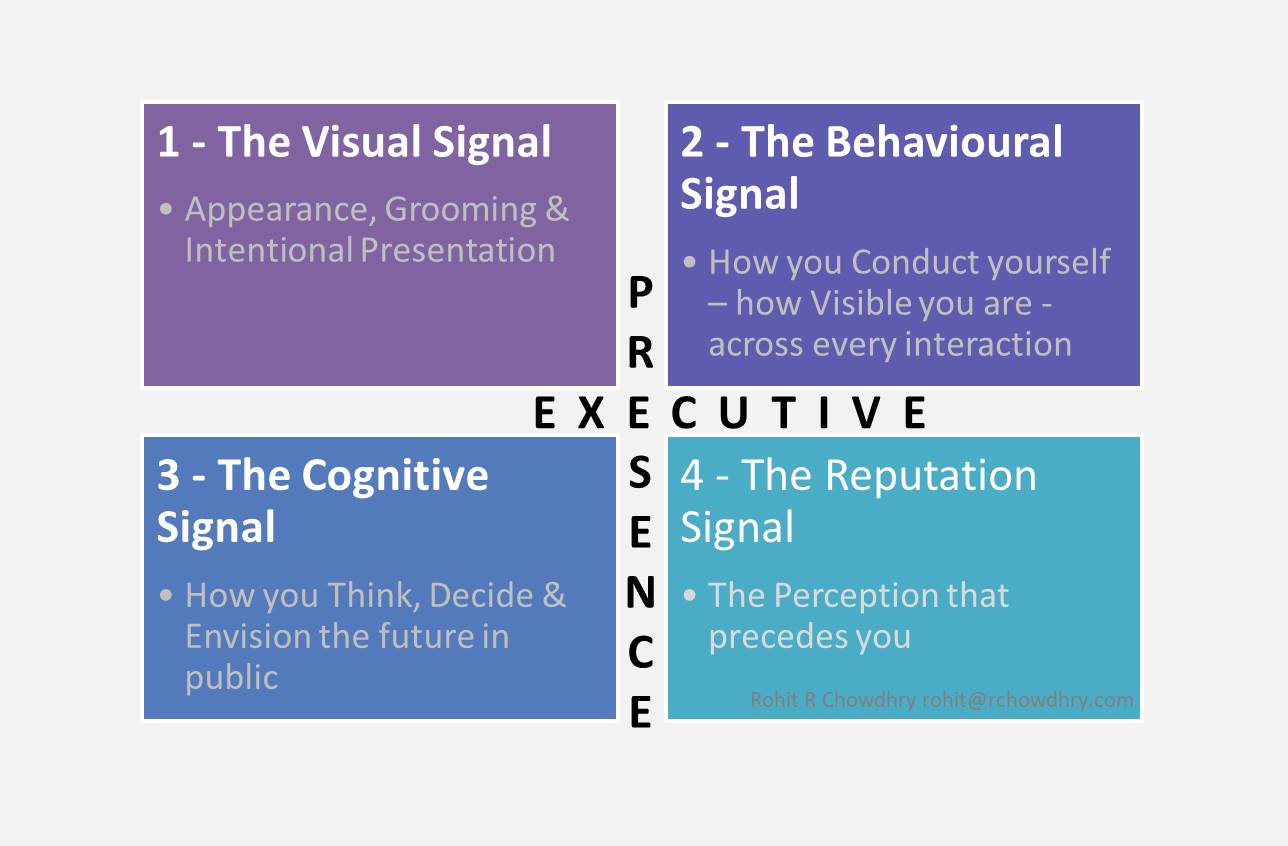
What I find in my coaching work – and what I want to offer here – is a framework that is both grounded in this research and practically navigable. Four dimensions. Each distinct. All of them connected.
Dimension 1 – The Visual Signal: Appearance Still Matters
Let me be direct about something many organisations are reluctant to say out loud: how you look matters. Not in a superficial, judgmental way – but in a deeply human, neurological way. Research in social psychology shows that we make subconscious assessments of competence, trustworthiness and authority within seconds of meeting someone, based largely on non-verbal and visual cues.
Many workplaces today have embraced a “dress as you like” culture. That is a positive evolution – it creates psychological safety and removes arbitrary barriers. But a misunderstanding often follows: that “dress as you like” means “appearance has no professional consequences.” It does not mean that at all.
CONSIDER THIS You arrive at a senior client meeting in chappals, a casual kurta and yesterday’s stubble. No one in your organisation will say anything – the culture does not permit it and the intent is not to judge. But here is the real question: What are you communicating? To the client sitting across the table, to your team watching how you show up, to the stakeholder quietly deciding whether you are someone they want to sponsor – your appearance is already sending a signal. The message may be unintentional (both for the transmitter & the receiver!) But it is never absent. |
The principle is not conformity. It is intentionality. In a tech start-up, executive presence might mean a well-fitted hoodie and clean sneakers. In a law firm, it means a sharp suit. In a GCC leadership context, it means understanding the culture of the room you are walking into – and dressing one level above it, not thee levels below.
For leaders moving into management for the first time, this often means a genuine investment – in your wardrobe, in grooming, in the small details that signal you take yourself, your role and the people you meet seriously. It is not vanity. It is professional self-awareness.
Research note: A Brown University analysis of executive presence observed that top leaders “present a visual image that says, ‘I’m a leader here’” – regardless of the environment they operate in, from a start-up basement to a Fortune 100 boardroom. The context changes; the intentionality does not.
Dimension 2 – The Behavioural Signal: How You Conduct Yourself
This is the most visible dimension – and the most observed. Every interaction you have, every meeting you attend, every email you send is a behavioural data point that others are collecting about you, often without conscious awareness.
Behavioural presence covers a wide canvas: how you carry yourself physically, how you speak (pace, clarity, whether you fill silence with noise or let ideas breathe), how you write (crisp and purposeful or long and hedging), how you listen (actively and generously or waiting for your turn to talk) and critically – how you behave under pressure.
CONSIDER THIS A project review goes wrong. The data is off. A stakeholder is visibly irritated. One leader in the room begins to over-explain, gets defensive and talks too fast. Another acknowledges the gap, stays calm and redirects to what will be done next. Both are equally competent professionals. But only one is demonstrating the composure that leadership presence requires. The room remembers that second leader – and so does the stakeholder. |
Written communication deserves its own attention. Many leaders underestimate how much their emails, messages and presentations reveal about their thinking. An email that takes three paragraphs to say what could be said in three lines signals confusion, not thoroughness. A presentation that buries the conclusion in slide 14 signals that the leader has not yet learned to lead with impact.
One of the most underrated behavioural dimensions is contextual adaptability. How you behave in a 1-to-1 with your manager is not the same as how you should behave in a cross-functional leadership meeting. The informality, the shorthand, the directness that works between two people who know each other well – that does not automatically translate to a wider room. Leaders who do not make this adjustment often come across as inappropriate, self-referential or unaware.
Behaviour also includes something that many middle managers underinvest in: visibility. Not self-promotion – visibility. There is a meaningful difference. Self-promotion is about making yourself look good. Visibility is about making yourself known, trusted and dependable across the people who matter to your organisation’s work.
This means actively leveraging different forums – team meetings, leadership reviews, client conversations, cross-functional sessions – to demonstrate that you understand what is going on and what needs to be done. It also means varying the means by which you communicate and connect: a written update to your stakeholders, a structured one-on-one with a key client, a town hall where you speak with clarity and conviction, a brief note to your team after a significant milestone. Each medium carries a different signal. Together, they build a picture of a leader who is engaged, present and worth paying attention to.
CONSIDER THIS Two leaders run equally high-performing teams. One delivers results quietly – heads down, execution focused, minimal external communication. The other does the same, but also shares a monthly stakeholder update, participates visibly in leadership forums and checks in regularly with peers in adjacent functions. When a new strategic initiative needs a lead, the decision is not difficult. Visibility, done with substance and consistency, is itself a signal of leadership readiness. |
Dimension 3 – The Cognitive Signal: How You Think in Public
This is the dimension most closely linked to what Hewlett called gravitas – the quality that her research consistently identified as the most critical component of executive presence. But I prefer to frame it differently: it is not just about having gravitas. It is about how your thinking lands with others.
People form strong impressions of your intelligence and leadership capacity not just from what you say, but from how you reason. The way you approach a problem, frame a decision, handle ambiguity and connect individual issues to the bigger picture – all of this is being observed, interpreted and remembered.
CONSIDER THIS Two leaders are asked the same question in a town hall: “How should we think about this restructuring?” One gives a thorough, technically correct answer that focuses entirely on her function’s perspective. The other acknowledges the complexity, references the broader organisational context, surfaces the human dimension and offers a balanced point of view. Both are competent. But only one is thinking like an executive. The second leader has demonstrated the cognitive range that senior stakeholders look for. |
The transition from individual contributor to manager is, fundamentally, a transition in thinking style. As an individual contributor, you were rewarded for depth – for being the expert in your lane. As a leader, you are increasingly evaluated on breadth – your ability to see across lanes, connect dots and hold complexity without collapsing it into a premature answer.
Decision-making style also matters here. Leaders who are chronically indecisive or who always defer upward, signal that they are not ready for the weight of leadership. Leaders who are brutally decisive without consultation signal that they do not understand how power works in organisations. The cognitive presence that earns trust is the ability to think with rigour, decide with confidence and remain genuinely open to being wrong.
But the cognitive shift that matters most – and the one that most clearly separates managers from executives – is the move from operational to strategic thinking. Operational thinking asks: how do we get this done? Strategic thinking asks: why does this matter, where are we headed and are we working on the right things in the first place?
Leaders with strong cognitive presence develop a point of view about the future – for their team, their function and their organisation. They have a sense of direction, a vision of what good looks like two or three years from now and a roadmap, however rough, for how to get there. Crucially, they create the conditions for their teams to think this way too – making space for bold ideas, encouraging people to look up from the day-to-day and treating innovation as part of the work rather than a distraction from it.
CONSIDER THIS A leader is asked in a senior leadership review: “Where do you see your function in three years?” One leader describes the current roadmap – projects underway, headcount plans, process improvements. Another describes a vision: what the function will need to become as the business evolves, the capabilities being deliberately built, the bets being made on technology or talent and the one or two big ideas the team is exploring that could change how the organisation works. Both are valuable. But only one is demonstrating executive-level thinking. Teams and stakeholders look to leaders not just to manage what is – but to shape what could be. |
Research note: A 2024 meta-analysis found a consistent positive association between Emotional Intelligence and Leadership Effectiveness – with high-EQ leaders demonstrating clearer communication, better handling of complex situations and stronger organisational outcomes. Thinking well, it turns out, is inseparable from feeling well.
Dimension 4 – The Reputation Signal: The Perception that Precedes You
The fourth dimension is the one that most frameworks underplay – and the one that, in my observation, has the longest shadow on a leader’s career.
The conventional framing of reputation – “what people say about you when you are not in the room” – is true, but incomplete. It captures only part of the picture. In practice, reputation travels much further than that. A senior stakeholder forms a view of you before you have ever been introduced. A potential collaborator in another function has heard your name from a colleague. A client has read something you wrote on LinkedIn. A leadership team in another geography knows you by your work, your ideas and the way people speak about you.
Reputation, in other words, is the perception that precedes you. It is built not just through direct interaction, but through the trail you leave – in the quality of your communication, the consistency of your positions, the generosity with which you treat others and the body of thinking you put into the world over time.
“The most powerful version of reputation is one that opens doors before you walk through them – built quietly, through consistent action, long before anyone is watching for it.”
Thought leadership is increasingly central to this dimension – and not just for public-facing roles. Leaders who develop a clear and distinctive point of view on topics relevant to their domain build reputational capital that extends well beyond their immediate team. Publishing a perspective on LinkedIn, contributing a well-reasoned position in a leadership forum or being consistently known as the person who can be trusted to offer a considered view – all of these compound over time into something that is hard to manufacture quickly and very hard to take away.
CONSIDER THIS Two leaders of equivalent seniority are being considered for a regional role. One is technically excellent but known for being territorial – he gets defensive when his decisions are questioned and tends to play down the contributions of his team. The other is slightly less technically polished, but she is known for being generous, intellectually honest and consistent. She says the same things publicly and privately. When the talent committee meets, the decision is not really about the technical gap. Reputation has already decided. |
Reputation is also where consistency becomes non-negotiable. Leaders who present one version of themselves to senior management and another to their teams or who change their positions based on who is in the room, erode trust in ways that take years to rebuild. Authenticity is not just a virtue – it is a strategic asset.
A Practitioner’s Note – The Wider Lens: What Leadership Settings Demand
There is one more idea I want to leave you with – and it sits across all four dimensions.
Most leaders have strong views, preferences and habits. That is not a problem. In fact, conviction is part of what creates presence. The challenge arises when those views are brought unchanged into settings that require a wider lens.
In a 1-to-1 conversation with your manager or a trusted colleague, you can be direct, narrow, opinionated, even blunt. The relationship holds that. But in a team meeting, a stakeholder presentation or a cross-functional leadership forum, the same behaviour can read as self-serving, tone-deaf or simply unaware.
Executive Presence in broader settings requires the ability to expand your frame – to consider perspectives that are not your own, to hold your view lightly enough to genuinely hear others, to be diplomatically honest rather than brutally direct. This is not weakness. It is the discipline of leadership.
THE DISTINCTION MATTERS There is a difference between being inclusive and being spineless. A leader with strong Executive Presence in group settings can hold a clear point of view and still create the conditions for others to contribute meaningfully. They do not dominate – they orchestrate. They do not suppress complexity – they name it. They do not pretend to agree – they demonstrate that they have genuinely listened before disagreeing. |
This is also where the research is landing. Deloitte’s 2024 Global Human Capital Trends report identified empathy, adaptability and emotional intelligence as the defining qualities of leaders who build trust in complex environments. The shift in executive presence thinking – from performative authority to genuine resonance – is not a softening of standards. It is a raising of them.
Executive presence is not a personality type. It is not reserved for extroverts, for people with charisma or for those who look a certain way. It is a set of choices – about how you present yourself, how you conduct yourself, how you develop your thinking and how you build your reputation – made consistently, over time, across contexts.
The leaders I coach who grow most visibly in this area are not necessarily the ones who overhaul themselves. They are the ones who start paying attention – to all four dimensions, not just the one they were already good at. They invest in a wardrobe. They slow down when they speak. They make themselves visible in the right forums and through the right channels. They develop a point of view about the future – and put it in writing. They ask, genuinely, what people think of them – and they listen to the answer.
That willingness to see yourself as others see you – and to invest in what you find – is, in itself, a form of executive presence.
Rohit R Chowdhry is a leadership coach and the author of The Future-Ready GCC Leader (written for the transition facing GCC leaders – from Excellence to Evolution) and The Future-Ready GCC (practical strategies to transform GCCs from Cost Centres to Innovation Hubs). He works with leaders across organisations to build the capabilities needed for the next stage of their growth.
Rohit Chowdhry is an Executive Coach, Leadership Advisor and Author with over three decades of experience, including 18 years at Deloitte leading Global Capability Centres. He works with GCC leaders navigating the transition from operational excellence to enterprise influence.