Coaching, Advisory & Thought Leadership — converging to build future-ready leaders.

  +91 9849106260  [email protected]              

The NAVIGATOR Framework

A leadership style framework built to help leaders understand how they naturally lead, how others around them lead differently and how to work together more effectively because of it.

WHY This Matters

Two equally capable leaders can still struggle to connect – not because either is wrong, but because they navigate differently.

You present an idea exactly the way it makes sense to you, and it just doesn’t land – because you haven’t quite adapted it to how the other person actually processes things.

A colleague doesn’t respond the way you expected, and it’s hard to pinpoint why – because you haven’t yet learned to read their style.

You’re meeting a stakeholder for the first time, you’ve done your homework on them – but you’re not sure how to turn that into a way of communicating that actually connects.

In a geographically dispersed, cross-cultural GCC environment – and in an AI era where human collaboration is becoming the real differentiator – knowing how to read and adapt to these differences isn’t a soft skill. It’s a leadership skill.

The Foundation for - The NAVIGATOR


The Navigator Framework was developed by Rohit R. Chowdhry, drawing on 2 dimensions that surfaced consistently across years of 1:1 executive coaching conversations:

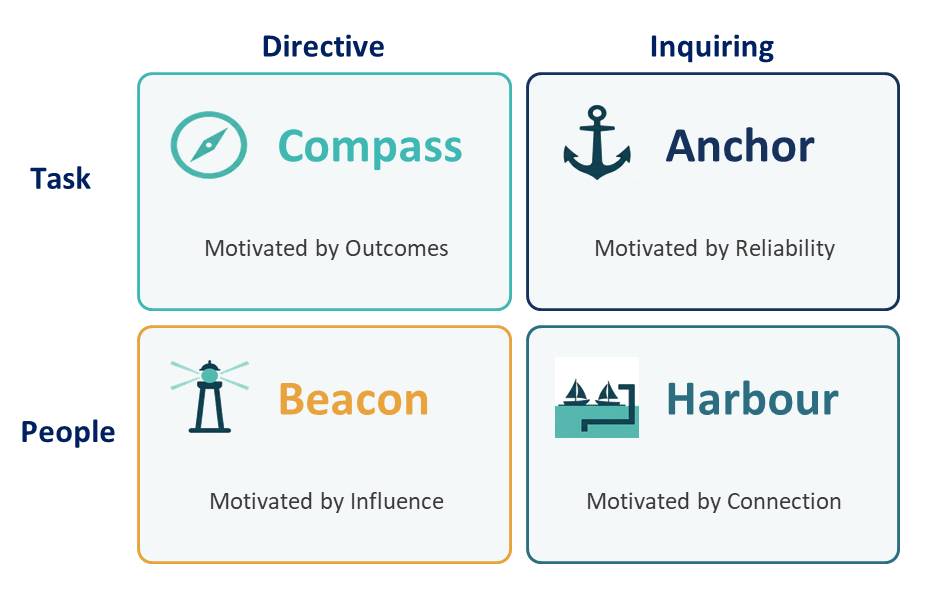
Task-orientation versus People-orientation, and Directive versus Inquiring communication style.


These 2 dimensions echo patterns that have shown up across decades of leadership and behavioural research – from the Ohio State Leadership Studies and the Managerial Grid to models like DISC and Social Styles. 

The Navigator applies these well-established behavioural dimensions, shaped by patterns observed across real coaching engagements, into a structure built specifically for how leaders navigate today’s dispersed, AI-era workplace.


Task vs People describes what someone optimises for when working with others – prioritising the outcome and what needs to get done, or prioritising the people involved and how it affects them.

Directive vs Inquiring describes how someone communicates and drives decisions – a “tell” style that declares direction and holds firmly to their own view, versus an “ask” style that gathers input, listens closely, and builds toward a decision rather than rushing to one.

Together, these 2 dimensions map 4 distinct leadership styles.

WHICH one sounds most like You?

COMPASS – Outcomes
Sets a clear direction and moves fast towards it.

BEACON – Influence
Leads by rallying people and energy behind a bold idea.

ANCHOR – Reliability
Gets the details and process right before committing.

HARBOUR – Connection
Builds trust and brings people together before moving forward.

Why it Matters - For You, For Your Team

For individual leaders:

Understand your own default style and blind spots. Read your colleagues, stakeholders and clients faster – and adjust how you communicate accordingly, instead of relying on guesswork.

For organisations:

Break down the friction that quietly slows cross-functional collaboration. Build better-balanced leadership teams. Strengthen how leaders manage stakeholders across dispersed, global teams.

How You Experience It

The Navigator Framework is delivered as a facilitated workshop – 3 hour/half day or 6 hour/full day formats – or woven into 1:1 executive coaching.

Participants leave with a clear sense of their own style, a practical way to read others and concrete ways to adapt in the moments that matter most – meetings, feedback, decisions and disagreement.

About the Facilitator

Rohit R. Chowdhry has over 33 years leading offshoring, business transformation and GCC set-up and scale-up for global organisations.

An executive coach and author, he specialises in leadership development and building high-performance cultures – this framework grew directly out of that coaching work.